Irregularly Sampled Time Series Interpolation for Binary Evolution Simulations Using Dynamic Time Warping
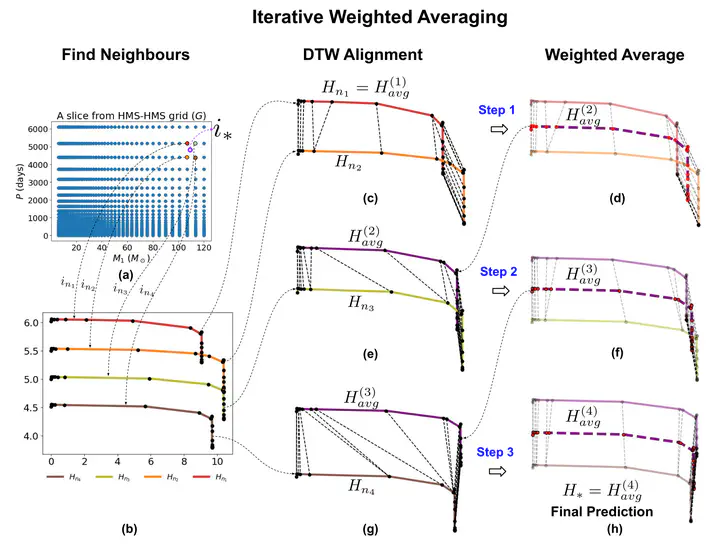 Shared warping path alignment for binary stellar tracks using DTW.
Abstract
Binary stellar evolution simulations are computationally expensive, yet they are fundamental to stellar population synthesis. While single-star track interpolation is straightforward, the interactions in binary systems—such as mass transfer and tidal forces—introduce discontinuities that make traditional methods inapplicable. In this work, we introduce a novel approach for track alignment and iterative track averaging based on Dynamic Time Warping (DTW). Our method computes a single shared warping path across all physical parameters simultaneously, placing them on a consistent temporal grid that preserves causal relationships. We demonstrate that this joint-alignment strategy maintains key physical laws, such as the Stefan-Boltzmann law, in the interpolated tracks, consistently outperforming standard interpolation methods across multiple binary configurations.
Ugur Demir, Philipp M Srivastava, Aggelos K. Katsaggelos, Vicky Kalogera, Santiago L Tapia, Manuel Ballester, Shamal Lalvani, Patrick Koller, Jeff J Andrews, Seth Gossage, Max M Briel, and Elizabeth Teng
Abstract
This research addresses the computational bottleneck of population synthesis by introducing a robust interpolation scheme for binary stars. Unlike single-star evolution, binary tracks are often irregularly sampled and plagued by misaligned evolutionary phases due to mutual interactions.
By employing Dynamic Time Warping (DTW), we generate a joint alignment that preserves the underlying microphysics across the entire track, enabling the rapid generation of high-fidelity binary models for large-scale simulations like POSYDON.
BibTeX Citation
@misc{demir2026irregularlysampledtimeseries,
      title={Irregularly Sampled Time Series Interpolation for Binary Evolution Simulations Using Dynamic Time Warping},
      author={Ugur Demir and Philipp M. Srivastava and Aggelos Katsaggelos and Vicky Kalogera and Santiago L. Tapia and Manuel Ballester and Shamal Lalvani and Patrick Koller and Jeff J. Andrews and Seth Gossage and Max M. Briel and Elizabeth Teng},
      year={2026},
      eprint={2604.13604},
      archivePrefix={arXiv},
      primaryClass={astro-ph.SR},
      url={https://arxiv.org/abs/2604.13604},
}

Patrick Koller
PhD Candidate
I work on scientific machine learning, focusing on physics-informed neural networks, neural operators, and large-scale physical simulations.